Newborn Nights With a Partner: How to Split the Night

The simplest way to survive newborn nights with a partner is to split the night into two shifts, so each of you gets one protected block of about 4 to 5 hours of sleep. One long stretch of real sleep makes a big difference for most adults. The goal is not perfect fairness. It is two rested parents, most nights. This guide covers four shift models, what to do if one of you is breastfeeding, a handoff log, scripts for the conversation and a weekly check-in.
Ground rules
- Protected block. A stretch of about 4 to 5 hours when the off-duty parent sleeps, with earplugs or in another room if possible.
- On duty means all of it. Diapers, settling and feeds (or bringing baby to the nursing parent). No tapping in the other parent.
- Swap when it hurts. If one shift is rougher, trade next week. Review on Sunday.
- Safe sleep on every shift. Whoever is on duty keeps baby on their back, on a firm, flat surface, in an empty crib or bassinet. If you might doze while feeding, plan it so baby goes down before you do. Never fall asleep with baby on a sofa or armchair.
Four shift models
No model is the right one. Choose by who feeds, who works in the morning and how your baby's night usually runs. Pick one to try for three nights.
| Model | How it works | Good when |
|---|---|---|
| Early / late | Parent A on duty 9 p.m. to 2 a.m., Parent B sleeps. Parent B on duty 2 a.m. to 7 a.m., Parent A sleeps | Both parents feed with bottles, or you pump ahead |
| Late / early (swap) | Parent B takes 9 p.m. to 2 a.m. and Parent A takes 2 a.m. to 7 a.m. | One parent is a night owl and the other is an early riser |
| By feeds | One parent handles feeds 1 and 2, the other handles feeds 3 and 4 | Baby's feeds are predictable and bottle-fed or pumped milk is available |
| Weekend swap | Weekdays: the parent who works outside the home gets the protected block. Weekends: flip | One parent has an early start Monday to Friday |
It is normal if the plan falls apart in week one or two. Newborn nights are unpredictable. Start again the next evening with no blame.
If one of you is breastfeeding
The nursing parent can still get protected sleep. The non-nursing parent can take everything around the feed so the nursing parent only does the feed itself.
- The non-nursing parent wakes first, changes the diaper and brings baby to the nursing parent.
- The nursing parent feeds, ideally in bed or a comfortable chair with good support and lights low.
- After the feed, the non-nursing parent burps baby, re-settles baby on their back in the crib or bassinet and handles the next diaper.
- The nursing parent goes straight back to sleep.
Pumping: some families add one bottle of pumped milk for one shift so the nursing parent gets a longer block. Many lactation professionals suggest waiting until breastfeeding is well established, often a few weeks. Ask your own lactation consultant or pediatrician about timing for you. A bottle in the night does not make you less of a parent.
If you might fall asleep while feeding, feed in your bed with all pillows and blankets moved away rather than on a sofa or armchair, and put baby back in their own sleep space when the feed ends.
A handoff log
A quick log means the off-duty parent does not need to ask "what happened?" at the handoff. Jot down:
- Time of last feed and how it went
- Last diaper change time
- When baby fell asleep and where baby is now (on the back, in the crib or bassinet)
- Anything that was fussy, new or worrying
- Pumped milk or formula ready for the next feed
- One thing the next shift needs to know
A layout for this is described in newborn feeding and sleep log.
How to talk about it
Sleep-deprived conversations go sideways fast. Pick a time when baby has just been fed and you are both fed and sitting down. Not at 3 a.m. Ten minutes is enough. A few scripts to borrow:
- "I'm running low. Can we try a protected block for me tonight, and I'll take tomorrow's?"
- "What would make the 2 a.m. shift easier for you?"
- "I'm not blaming you. I'd like to figure out a plan together."
- "Thank you for taking last night. I saw how hard it was."
A five-minute Sunday check-in
- One thing that worked this week.
- One thing that was hard.
- Anything to swap next week?
- What help can we ask for? (meals, errands, a nap)
- Plan the first three nights.
Make hard stretches easier
Evening fussiness often peaks around 6 weeks. Line up a hand-off in advance and decide when you will step outside for five minutes. See newborn growth spurts and fussy weeks. Put a fridge sheet where you both see it with the protected sleep windows, who handles diapers after the feed, one break each person will take and the pediatrician's phone number.
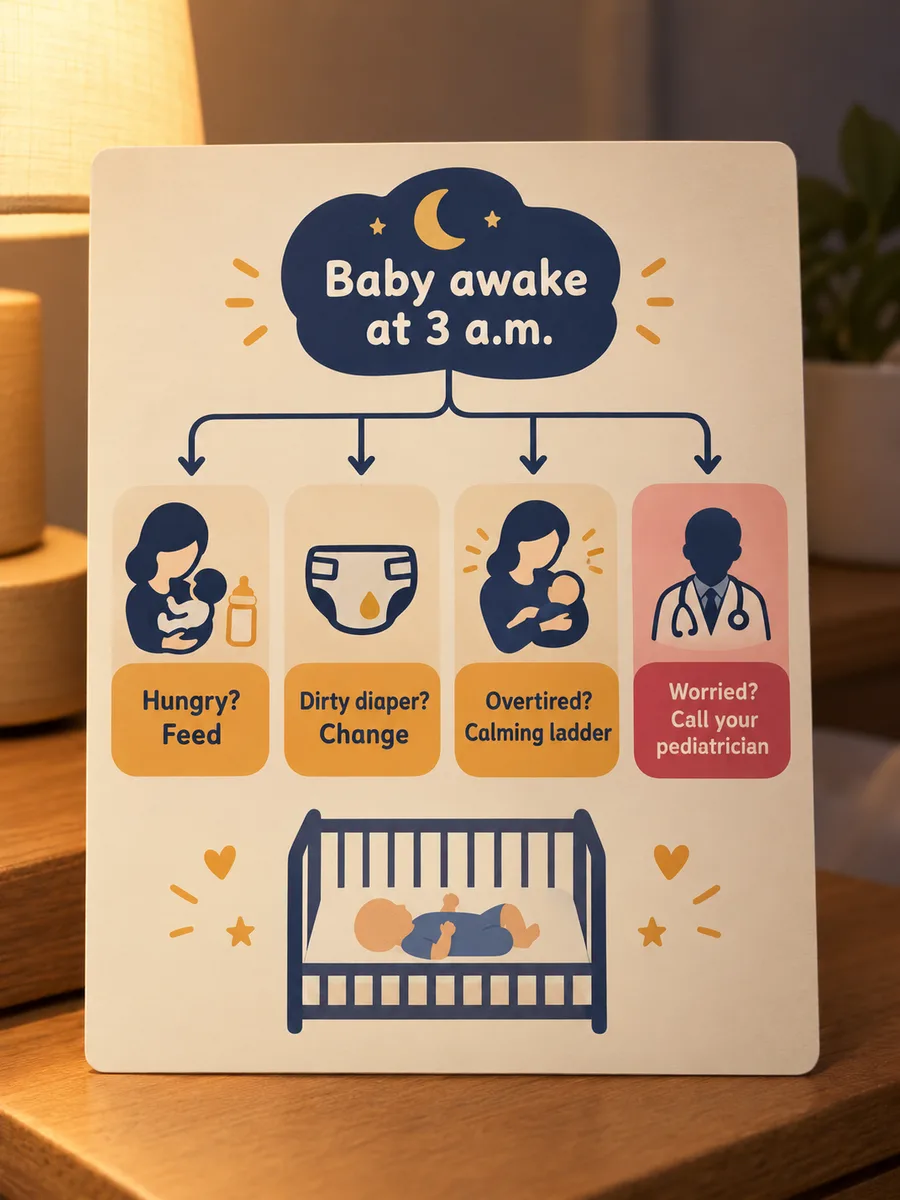
If you are doing it alone
Ask someone to cover at least one block of the day so you can sleep. A helper can watch baby in the same room while you rest in another. Baby stays in their own safe sleep space where an awake adult can hear and see them. See the first two weeks checklist for tasks to hand off.
When it is more than tired
Many new parents feel weepy, anxious or overwhelmed in the first two weeks after birth. If these feelings last longer than two weeks or are getting worse, it may be postpartum depression or anxiety. These conditions are common and treatable and can affect any new parent, including fathers and partners. Tell your doctor or midwife. In the U.S., call or text the 988 Suicide & Crisis Lifeline, or call 911 in an emergency.
Planner pages
The Newborn Sleep Playbook includes a bonus Partner Night-Shift Planner with these four models, a weekly shift planner, a shift log and handoff notes, and a fridge sheet, plus a chapter on taking care of yourself. It is educational and does not replace your pediatrician's advice.