How to Swaddle a Newborn Safely (and When to Stop)
A safe swaddle keeps the baby on their back, snug across the chest, loose around the hips and legs, with nothing covering the face, and it stops at the first signs your baby is trying to roll. Many videos show the folding steps. This guide covers the part videos tend to skip: the safety rules, the signs it is time to stop and how to make the change. Swaddling is a tool, not a requirement. It can calm the startle reflex and help some babies stay asleep longer, but it works for some babies and not others. If yours hates it, skip it.
Safe swaddle rules
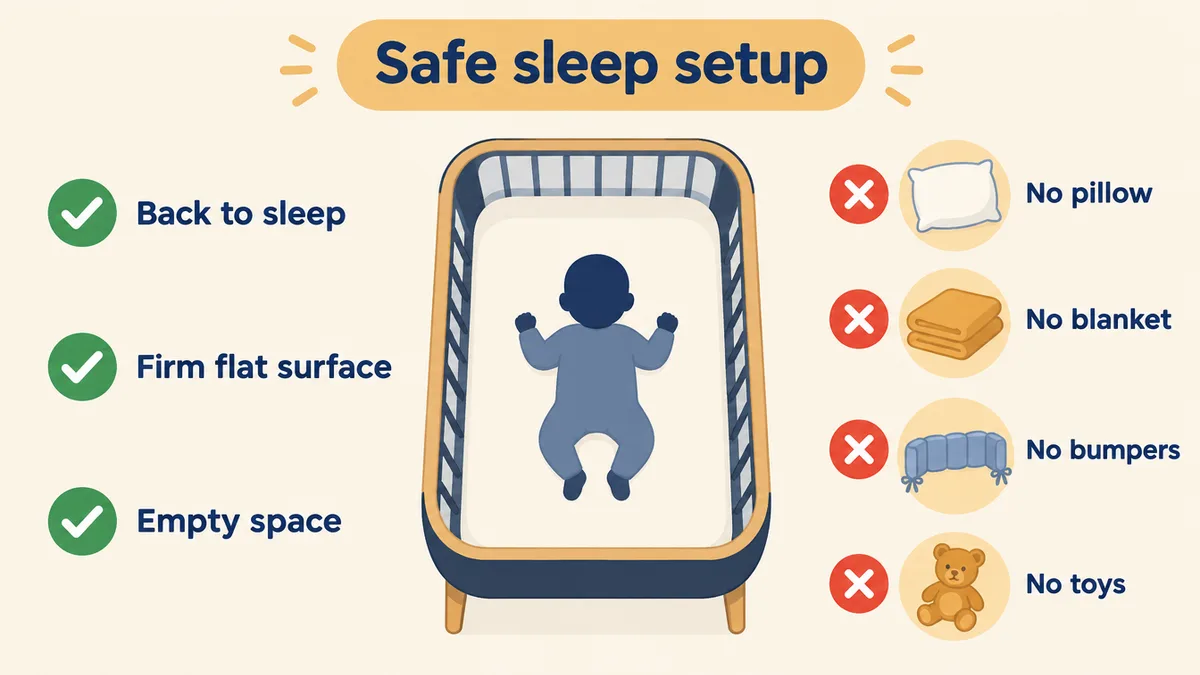
- Back sleeping only. Place a swaddled baby on their back for every sleep.
- Snug across the chest, loose at the hips. Keep the wrap snug at the chest but not tight. Legs should be able to bend up and out.
- Never over the face. A swaddle should never cover the face or the head. Keep the fabric below the shoulders.
- Thin, breathable fabric. Keep the room comfortable. Avoid overheating: check the chest and neck for sweating or heat.
- Nothing extra. No loose blankets, pillows or toys in the crib.
- Stop at the first signs of rolling. Often around 2 months, sometimes earlier.
Step by step
There are many ways to fold a blanket. This is a simple one, with the safety checks at each step.
- Lay out a thin, square blanket in a diamond shape, with the top corner folded down.
- Place baby on their back with shoulders just below the folded edge.
- Wrap one side across the chest and tuck it under the opposite side. Keep arms straight or bent as comfortable for the baby.
- Fold the bottom up loosely over the feet, leaving room for the hips and legs to bend. Never pull the legs straight and tight.
- Wrap the second side across and tuck it under. The wrap should be snug at the chest but not tight, so baby can breathe easily.
- Check: face clear, hips loose, chest snug but not tight, baby comfortable.
Store-bought swaddle sacks with hook-and-loop flaps work the same way. Check the size and follow the maker's instructions.
Signs it is time to stop
The AAP advises stopping swaddling as soon as a baby shows signs of trying to roll over. A swaddled baby who rolls onto their tummy may not be able to push up or turn back.
- Rocking onto their side during tummy time or sleep
- Lifting shoulders and pushing up strongly
- Wriggling an arm or both arms out of the swaddle
- Getting a leg over to one side
How to stop
Two common ways:
- Straight away. Stop swaddling at the next sleep. Expect a few rough nights as your baby discovers their hands.
- Step by step. For a few nights, swaddle with one arm out, then both arms out, then no swaddle. If your baby shows rolling signs, do not keep going with a partial swaddle. Move to the next step.
Once arms are free, dress your baby in a wearable blanket or sleep sack made for their size, with arms free. Try the first change at a nap, when you can watch more closely. Some babies startle and wake themselves, and this usually eases over several days. Place baby on their back every time, even if they roll over on their own. Once baby can roll both ways, you do not need to flip them back, but keep the crib empty.
If baby fights it
- Try a different tool. Skin to skin, shushing, white noise or gentle motion. See white noise for newborns.
- Leave a hand free. Some babies settle better with a hand near the face, but follow the maker's instructions.
- Skip it. Many babies sleep well without a swaddle.
Swaddling and the startle reflex
The Moro (startle) reflex makes babies fling out their arms suddenly, sometimes waking themselves. It is normal and usually fades by about 3 to 4 months. A safe swaddle helps some babies, but it is not the only option.
Swaddle mistakes to avoid
- A swaddle that is too tight at the hips
- A blanket that rides up toward the face
- Overheating from thick fabric or too many layers
- Swaddling after baby starts to roll
- Swaddling and then putting baby in a sleep position other than the back
- Using weighted swaddles or sleep products, which are not recommended for infants
Room, surface and routine
A swaddle does not replace safe sleep basics. Use a firm, flat surface with a fitted sheet and nothing else, in your room. See the safe sleep nursery setup. If swaddling stops around the same time your baby's sleep changes, see the 4 month sleep regression.
When to ask your pediatrician
Ask if you are unsure whether it is time to stop swaddling, if your baby is not showing movement milestones you expect, or if your baby has a hip condition. Call your pediatrician or 911 if you are worried about your baby's health.
More soothing tools
The Newborn Sleep Playbook covers swaddling as part of a wider soothing toolkit with a swaddle safety section, plus a bonus Safe Sleep Nursery Setup Guide and a set of 24 bedtime and soothing cards. It is educational and does not replace your pediatrician's advice. Based on public guidance from the AAP; always check with your own pediatrician.