4 Month Sleep Regression: Signs, How Long It Lasts and What Helps
The 4 month sleep regression is a rough patch in sleep that many families notice between about 3 and 5 months, when a baby's sleep reorganizes from the simple, light cycles of a newborn into lighter and deeper stages. The word "regression" sounds scary, but it is really a permanent shift in how your baby sleeps. A better word may be progression. This guide explains what is happening, what it can look like, what to do gently and what to leave alone.
What is actually changing
Newborn sleep is mostly one kind of light, quick-cycling sleep. Between roughly 3 and 5 months, many babies move toward sleep that has distinct lighter and deeper stages, with cycles that repeat through the night. Adults wake briefly between cycles and settle back without noticing. Babies are just learning how to do that. If they fall asleep a certain way, such as feeding or rocking, they may look for that same help each time they surface.
Common signs
- More frequent night wakings than a few weeks ago
- Shorter naps, sometimes 30 to 45 minutes
- More fussiness at bedtime
- More interest in the world, so baby is easily distracted during feeds
- Changes in appetite on some days
None of this means you did something wrong, and it does not mean your baby is unwell. Many families see a sleep change at this age.
How long does it last?
Nobody can tell you exactly how long. Some families notice it for a couple of weeks, others longer, and some barely notice it. Focus on small, repeatable steps and on getting rest where you can. Progress is usually gradual, not a single night.
Is it a growth spurt?
They can overlap. Growth spurts commonly bring extra hunger for a few days, and many babies have one around 3 months. The sleep change comes from brain development and tends to last longer. If baby seems hungry, offer extra feeds. See newborn growth spurts and fussy weeks.
What helps, gently
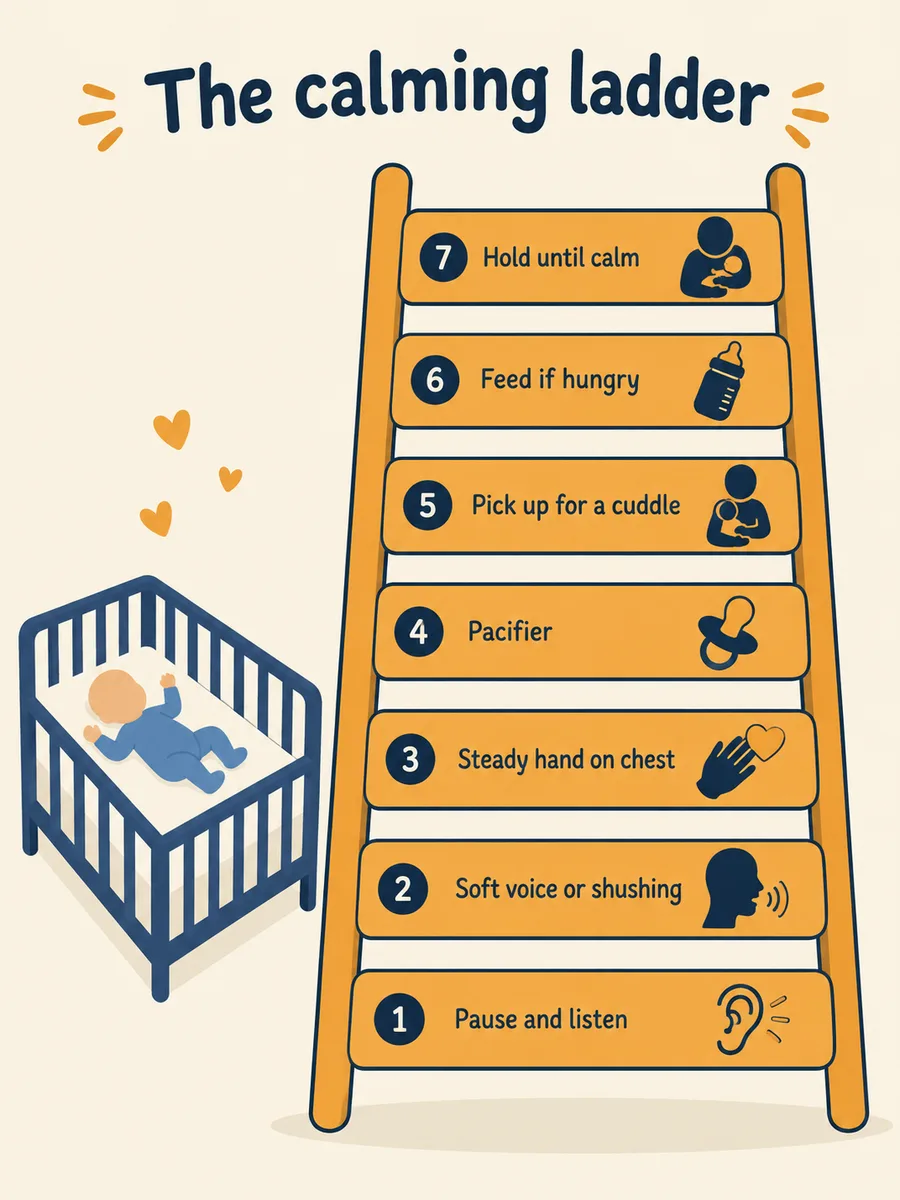
Pick one or two things, not ten.
1. A short, steady routine
Aim for 15 to 30 minutes, in the same order, in the same place, with dim lights and a quiet voice. A common order is: bath or wipe-down (optional), pajamas and diaper, a feed in a dim room, a short book or song, then into the crib on the back, with a sleep sack. Use the same goodnight phrase each night.
2. Awake windows that fit
At this age most babies can stay up a little longer than newborns. Commonly cited windows are about 75 to 120 minutes at 3 months and about 90 to 150 minutes at 4 months, shortest after the first wake-up and longest before bedtime. Cues beat the clock. See the 3 and 4 month old sleep schedule.
3. Separate eating from falling asleep, if you want to
Feeding is a lovely part of the routine. If you can, finish the feed before baby is fully asleep, or put a short activity after it, like a book or a song. This helps separate eating from falling asleep. It is optional.
4. Daylight and a dim night
Bright, lively days and dim, quiet nights help the body clock keep developing.
5. Take turns
Splitting nights keeps both adults functional. See newborn nights with a partner.
Leaving the swaddle safely
Rolling changes the safety rules. The AAP advises stopping swaddling as soon as a baby shows signs of trying to roll over, which can happen as early as 2 months. A swaddled baby who rolls onto their tummy may not be able to push up or turn back.
Signs it is time:
- Rocking onto their side during tummy time or sleep
- Lifting shoulders and pushing up strongly
- Wriggling an arm or both arms out of the swaddle
- Getting a leg over to one side
You can stop at the next sleep, or step by step: one arm out, then both arms out, then no swaddle. If baby shows rolling signs, do not keep going with a partial swaddle. Move to a wearable blanket or sleep sack with arms free. Try the first change at a nap, when you can watch more closely. Some babies startle and wake themselves for a few days. See how to swaddle a newborn safely.
What not to do
- Do not try ten new methods in a week.
- Do not change safe sleep rules to "get through it." No pillows, blankets, bumpers or soft toys, no inclined sleepers, no sleeping on a sofa.
- Do not assume every sleep change is "just the regression."
- Do not compare your baby to a friend's baby.
When to call your pediatrician
Call if baby has a fever, is feeding poorly, has fewer wet diapers than usual, seems very hard to wake, is unusually floppy, or breathes in a way that worries you. Call your pediatrician or 911 if you are worried about your baby's health. Do not assume it is "just the regression."
What comes next
As sleep cycles mature, many babies lengthen their naps around 5 to 6 months. See 6 month old nap schedule. Please note: The Newborn Sleep Playbook is written for weeks 0 to 12. A separate, paid playbook covers months 3 to 4 in more detail and is not part of this one. The 0 to 12 week playbook is educational and does not replace your pediatrician's advice. It includes a Fussy Weeks & Growth Spurts Calendar and a 12-week tracker, which can help you see patterns before this stage begins.