Newborn Won't Sleep Unless Held: Why It Happens and What to Try
A newborn who wakes the moment you lay them down is doing something very normal: they are asking for the closeness they had for nine months. This is one of the most common newborn sleep complaints, and in most cases it is not a sleep problem to fix. It is a stage. This guide explains why it happens and gives you gentle, safe things to try, plus ways to protect your own rest while you wait for it to pass.
Why newborns wake when you put them down
Several things come together in the first weeks:
- They are used to contact. Warmth, a heartbeat, movement and your smell all disappear when baby is placed on a flat mattress. Many newborns notice the change within seconds.
- Their sleep is light. Newborns spend about half of their sleep in active sleep, a lighter stage with twitching, noises and fluttering eyelids. They wake easily from it.
- Sleep cycles are short. A newborn sleep cycle is brief, so waking after 30 to 45 minutes is very common.
- The startle reflex. The Moro reflex makes babies fling their arms out suddenly, which can wake them as you lower them down. It usually fades by around 3 to 4 months.
- Tiny stomachs. Newborns need frequent feeds, so they are built to wake often.
None of this means you are doing something wrong. You cannot spoil a newborn by holding, feeding or comforting them.
First, make sure holding is safe
Holding a newborn to sleep is fine while you are awake. Safety rules matter most when you are tired:
- Stay awake and alert while baby sleeps on you.
- If you feel drowsy, move baby to a firm, flat sleep surface, on their back.
- Do not fall asleep with baby on a sofa or armchair. If you might doze during a night feed, feed in an adult bed with pillows and blankets moved away from baby, and put baby back in their own space as soon as the feed ends.
- Do not hold a sleeping baby if you have taken sedating medication or have been drinking.
The American Academy of Pediatrics (AAP) recommends that babies sleep on their back, on a firm and flat surface with nothing else in it, in the same room as a parent but not in the same bed. See the safe sleep nursery setup guide for the full checklist.
Gentle things to try
No single trick works for every baby. Pick one at a time and give it a fair try over a few days.
1. Start from the wake window, not the clock at bedtime
An overtired baby often fights the transfer. In the first weeks, many babies are ready to sleep again after an hour at most, usually less. See newborn wake windows by week for commonly cited ranges, and watch for the early signs in sleepy cues vs. overtired cues.
2. Wait for deeper sleep
If you lay baby down at the first sign of closed eyes, they are still in light sleep. Many parents wait until baby is limp: arms and legs feel heavy and floppy, usually around 15 to 20 minutes in.
3. Warm the surface and keep contact as you lower
Keep baby close to your body while you lower them, and let your arms stay in contact for a moment before pulling away. Some parents warm the sheet beforehand with a hand or a warm (not hot) towel, then remove the towel before baby goes down. Never put heating pads, hot water bottles or weighted products on or under a baby.
4. Use a calm hand on the chest
A steady, warm hand on baby's chest or back for a minute can help baby feel held after the transfer. Remove it once baby is asleep.
5. Add sound and a snug feel
Shushing or low white noise can remind baby of the womb. Keep the machine across the room, at conversation volume or lower. See white noise for newborns. If you swaddle, follow the safe-swaddle rules and stop at the first signs of rolling.
6. Try the drowsy-but-awake step once, not every time
Sometimes you can lay baby down calm and sleepy, but not fully out, and let them take the last step on their own. It may take many tries and often will not work in the first weeks. That is okay. Treat it as practice, not a test.
The calming ladder if baby protests
If baby wakes and fusses, move up one rung at a time and stop when baby calms:
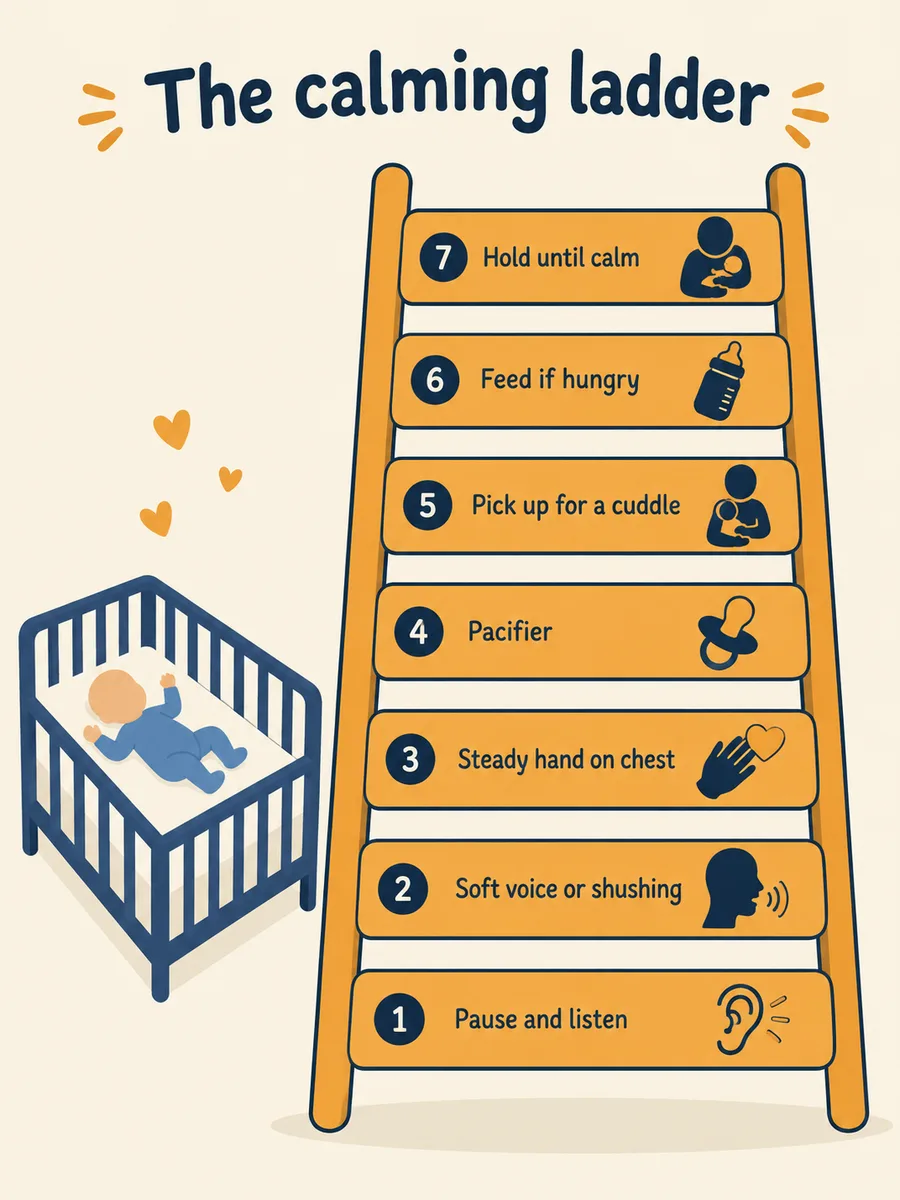
- Pause and listen for a moment. Newborns make noises in light sleep.
- Soft voice or shushing.
- A steady hand on chest or tummy.
- A pacifier, if you use one.
- Pick baby up for a cuddle.
- Feed if baby is hungry.
- Hold until baby is calm or asleep, then try again another day.
Pause for noises. Respond to cries. If you end up holding the whole nap, nothing has gone wrong.
Make the days easier on you
- Plan contact naps. Put water, a snack, a charger and the remote within reach before you settle in.
- Mix it up. Use contact naps when you need them and crib naps when you can.
- Take turns. While one adult holds, the other sleeps. A shift system is covered in newborn nights with a partner.
- Use a carrier when you are awake. Keep baby's face visible, chin off the chest, and follow the carrier's instructions.
When it is more than the usual
Newborns who only sleep when held are usually healthy. Call your pediatrician if baby is very hard to wake, feeds poorly, has fewer wet diapers than expected, has labored breathing, or has a fever of 100.4°F (38°C) or higher. Trust your instincts. Needing a break is also normal: if you are losing patience, lay baby on their back in the crib, step away for a few minutes and call someone for support.
Where to go from here
The gentle options above are covered step by step in The Newborn Sleep Playbook, including the soothing toolkit, the calming ladder, safe contact naps and a 7-day starter plan, so you can try one small thing a day instead of everything at once. It is educational and does not replace your pediatrician's advice.