3 and 4 Month Old Sleep Schedule: A Flexible Sample Day

Most 3 and 4 month old babies take about 3 to 5 naps a day with awake windows of roughly 75 to 150 minutes, and sleep is often easier to plan around a rhythm than a clock. Below you will find commonly cited awake windows, a sample day, tips for the move from four naps toward three and a note on what to do when the day goes sideways. These are ranges and examples, not targets. Your baby may be a little ahead or behind and still be completely healthy.
Awake windows at 3 and 4 months
At this age most babies can stay up a little longer than newborns. Use these ranges as a starting point and watch your baby.
| Age | Typical awake window | Common nap count |
|---|---|---|
| 3 months | about 75–120 minutes | 4–5 short to medium naps |
| 3.5 months | about 90–120 minutes | 3–4 naps |
| 4 months | about 90–150 minutes | 3–4 naps |
Windows are usually shortest after the first wake-up of the day and longest before bedtime. A typical day might run 90 minutes, then 105, then 120, then 135 before bed.
For the earlier weeks, see newborn wake windows by week.
Cues beat the clock
Start winding down when you see the first cues, or when you are near the end of the window. A baby who is overtired may be harder to settle, and a baby who is not tired enough may protest. Both are normal.
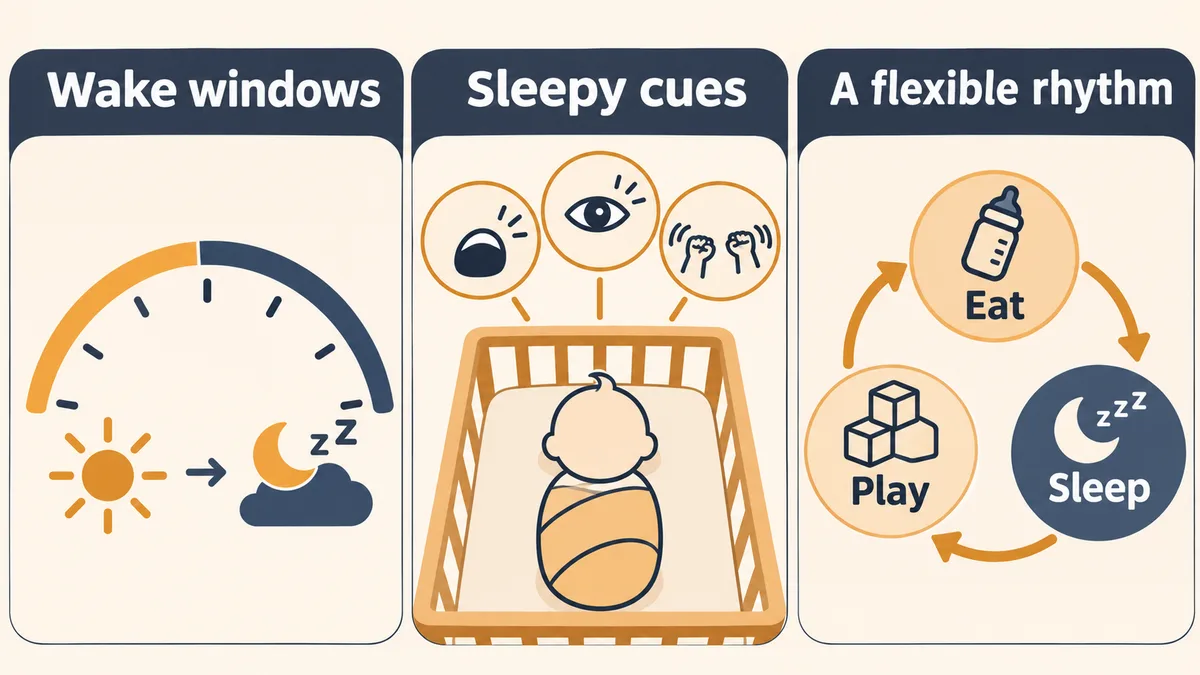
Sleepy cues to watch for:
- Staring into space or a glazed look
- Slower movements
- Redness around the eyebrows
- Quieter, less interested in toys or faces
- Yawning or rubbing eyes (often a late cue)
If your baby is fussy before the window ends, follow your baby. Try an earlier wind-down. Some babies need shorter windows early in the day.
A sample day at 3 to 4 months
Example only. Match the order and the spacing, not the minutes.
| Time | What happens |
|---|---|
| 7:00 | Wake, feed, daylight and play |
| 8:30 | Nap 1 |
| 10:30 | Feed, play, outside time |
| 12:00 | Nap 2 (often the longest) |
| 2:00 | Feed, play |
| 3:30 | Nap 3 (shorter) |
| 5:00 | Optional short nap, or a quiet cuddle |
| 6:15–7:30 | Bath, feed, bedtime routine |
Moving from four naps to three
Many babies move from four naps toward three between about 4 and 6 months. You do not need to force it. Look for patterns and let the schedule shift gradually.
- It tends to happen gradually, over weeks.
- The late-afternoon nap is usually the first to get squeezed out.
- On days with only three naps, bring bedtime a little earlier so your baby is not overtired.
- On busy days, a fourth short catnap is fine.
Short naps are common
At this age, naps of 30 to 45 minutes are very common. Many babies lengthen naps later, around 5 to 6 months, as their sleep cycles mature. If a nap ends early and baby is happy, take it as a short nap and move on.
Bedtime
A short, predictable routine tells your baby's body that sleep is coming. Aim for 15 to 30 minutes, in the same order, in the same place. See newborn bedtime routine for a starting point you can lengthen a little at this age.
When sleep gets messy
Around 3 to 5 months many babies go through a sleep change. If your 3 or 4 month old suddenly wakes more, see the 4 month sleep regression.
Night feeds and early waking
Many babies at this age still feed at night, and that is normal. Ask your pediatrician what is right for your baby before you try to change night feeds. If your baby wakes very early, a few things are worth checking: is the room dark enough, is the last window before bed too long or too short, and is morning light helping set the body clock? Offer a calm, boring response to early wakings, with dim light and little talking, and keep daytime light bright.
Make it your own
A schedule is useful only if it fits your life. Pick the sample day closest to your baby, then adjust. Write down wake-ups, naps and bedtime for three days with a scrap of paper or an app, circle the times that went easily and build around those anchors. If a day falls apart, that is not a setback. Start again at the next wake-up.
Safe sleep still applies
Every nap and night: baby on their back, on a firm, flat surface with a fitted sheet and nothing else. Room-share without bed-sharing for at least the first 6 months. If your baby shows signs of trying to roll, stop swaddling and use a wearable blanket with arms free.
Common questions
Should I wake my baby from a nap to keep the schedule? Usually not. Let a happy baby finish a nap, and adjust the next window if bedtime would otherwise be pushed very late.
What if my baby will only nap on me or in the carrier? Very common. Use contact naps when you are awake and alert, and mix in crib naps when you can. Always move baby to a flat surface if you feel drowsy.
Does a longer bedtime routine help now? Many families lengthen the routine a little at this age, to 15 to 30 minutes. Keep the order the same each night.
What comes next
Naps shift again from about 5 to 6 months. See 6 month old nap schedule.
About the product
The Newborn Sleep Playbook is written for weeks 0 to 12. It includes a wake windows chart, a daily rhythm planner and a bedtime routine checklist that carry over into this stage. A separate, paid 3–4 Month Sleep Playbook covers this age in more depth and is not part of this one. It is educational and does not replace your pediatrician's advice.