Newborn Wake Windows by Week: A Week 0–12 Chart
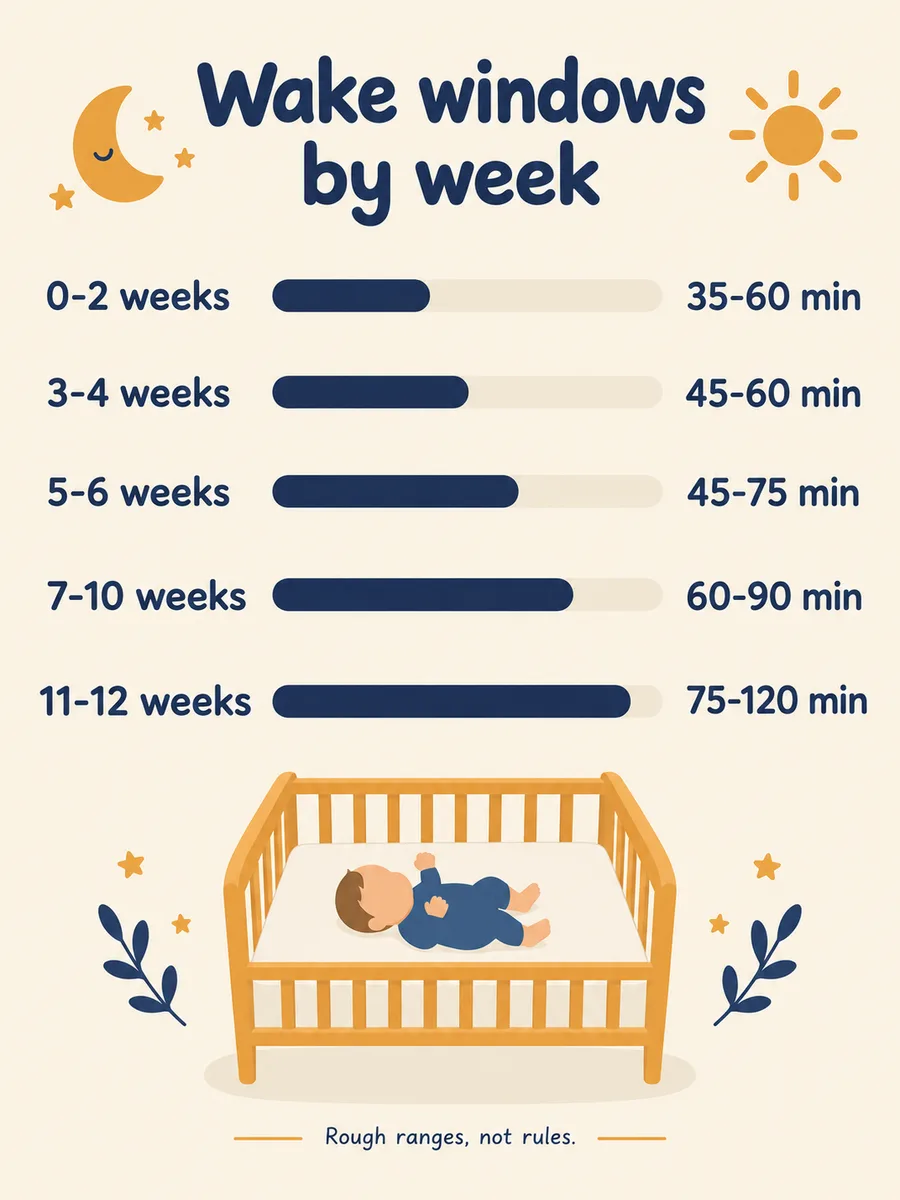
A newborn can usually stay comfortably awake for only about 20 to 60 minutes in the first weeks, and that window grows slowly to roughly 60 to 100 minutes by week 12. That is the short answer. Below is a week-by-week chart of commonly cited ranges, how to use it without turning the day into a stopwatch exercise, and what to look at when the numbers and your baby disagree.
Newborn wake windows by week
These are approximate, commonly cited ranges. Individual babies vary a lot. "Awake time" includes feeding.
| Age | Typical time awake between sleeps | What it can look like |
|---|---|---|
| Week 0–1 | 20–45 min | Feed, burp, change, back to sleep |
| Week 2 | 30–50 min | A little more alert time after feeds |
| Week 3 | 35–55 min | Brief calm-alert moments |
| Week 4 | 40–60 min | Starts to look around, may have a fussy stretch |
| Week 5 | 45–60 min | Eye contact, first social smiles around now for some |
| Week 6 | 45–65 min | Often a fussier period; windows may feel unpredictable |
| Week 7 | 45–70 min | Tummy time and play fit in |
| Week 8 | 50–75 min | Longer alert stretches in the morning |
| Week 9 | 55–80 min | Early evening is often the fussiest time |
| Week 10 | 60–85 min | Naps may start to settle into a loose pattern |
| Week 11 | 60–90 min | Windows may lengthen, especially the first of the day |
| Week 12 | 60–100 min | Many babies handle slightly longer windows by now |
Some healthy babies need shorter windows, and others stretch longer. A printable version of a chart like this is covered in the newborn wake windows chart.
How to use the chart
- Start counting when baby wakes. Not when you put them down.
- Start winding down a few minutes before the window ends. A short dim-and-quiet routine is plenty.
- Watch baby, not the clock. The chart is a backup for when you cannot read cues.
- Use the low end on hard days. On easy days the high end may work.
If you only remember three rules: in the early weeks assume baby is ready to sleep again after about an hour at most, usually less; watch the baby more than the chart; and shorter or longer is fine if baby is happy.
Why wake windows matter, and why not too much
When a baby has been awake a long time, their body can release stress hormones that make settling harder. A baby put down very early may not be tired enough to fall asleep easily. Aiming for a window that is roughly right, not perfect, makes sleep a little easier for many babies.
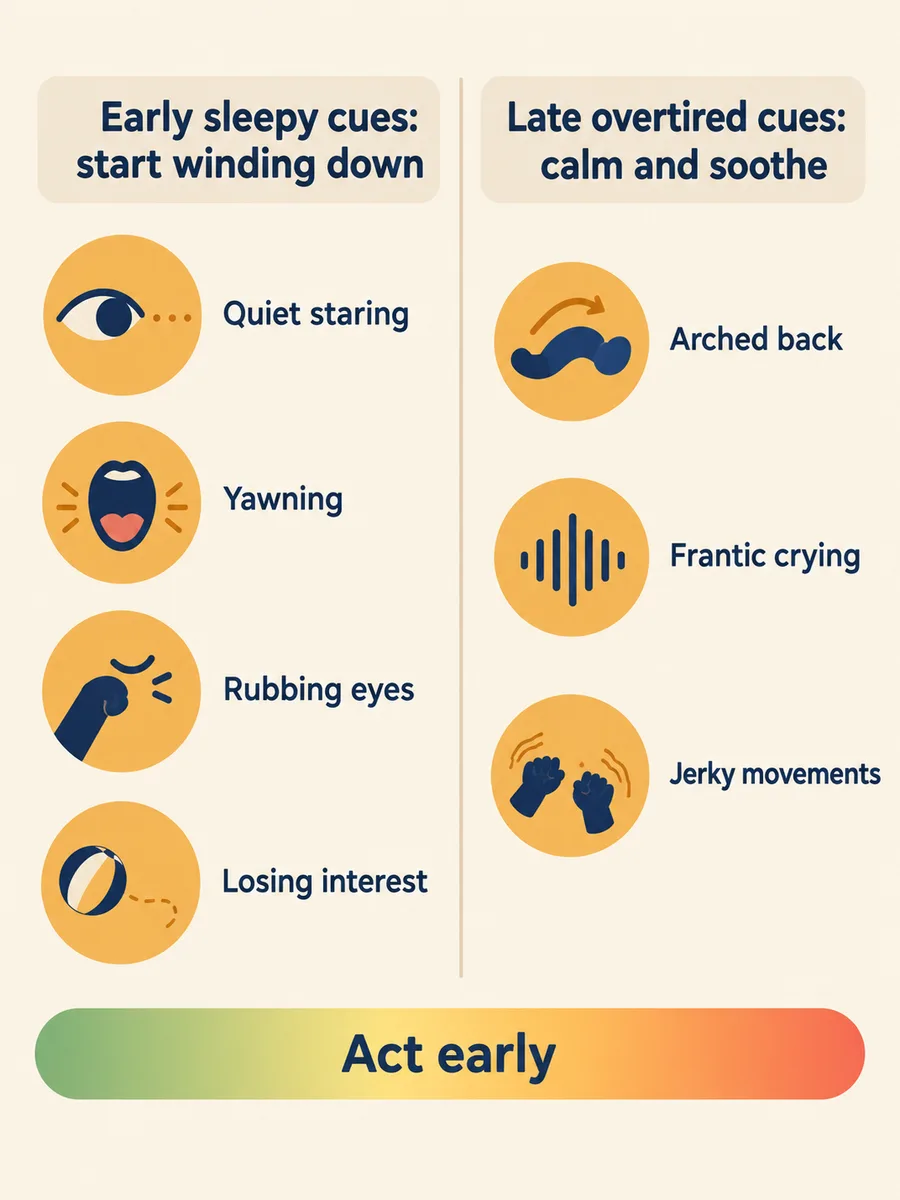
But wake windows are not an exact science. A cranky baby is not always tired. They may be hungry, wet, gassy, overstimulated or just wanting to be held. Rule those out too. See sleepy cues vs. overtired cues for what to watch for.
A sample day built on windows
Times are illustrative only. Match the order, not the minutes.
| Part of day | Weeks 0–4 | Weeks 9–12 |
|---|---|---|
| Morning | Wake, feed, diaper, brief play, nap | First wake-up, feed, play. Windows are a little longer |
| Midday | Feed, cuddle, walk, nap, often in your arms | Several naps through the day |
| Afternoon | Feed, short play, nap. Many babies cluster feed | Possible catnap to bridge to bedtime |
| Evening | Cluster feeding and fussiness are common | A consistent routine: feed, soft song, lay down drowsy |
| Night | Feed in low light, minimal talking, back to sleep | Feed in low light, minimal talking |
Many babies take four or more naps a day in the early weeks. By around weeks 9 to 12, three to five naps of varying length is common, but plenty of babies stay unpredictable. That is normal.
When the chart and your baby disagree
- Baby is awake two hours and happy. Some babies are wide-eyed and content for longer, and some days just go that way. If baby then gets very fussy, comfort them and try a calming wind-down. One long window will not cause harm.
- Baby is fussy before the window ends. Look for hunger, a dirty diaper, gas or overstimulation, then try an earlier wind-down.
- Baby sleeps for 30 to 45 minutes every time. Very common. Newborn sleep cycles are short and many babies wake at the end of one. Wait a minute or two when baby stirs to see if they resettle.
- Baby sleeps so long that feeds are missed. In the first weeks, ask your pediatrician how often to wake baby to feed.
Do I have to track wake windows?
Not strictly. A simple note on your phone of when baby woke is plenty. If you do track, use the web app or paper for a day or two to learn your baby's rhythm, and then stop if it adds stress. For a simple log layout, see newborn feeding and sleep log.
Safe sleep applies to every window
Whatever the clock says, every sleep goes on baby's back on a firm, flat surface with nothing else in it. If baby falls asleep in a car seat, swing or carrier, move them to a flat surface when you can. See the safe sleep nursery setup.
When windows start to change
Around 3 to 4 months, windows are longer and naps start to take shape. See the 3 and 4 month old sleep schedule.
Put the chart to work
The Newborn Sleep Playbook includes a wake windows chapter with this week-by-week table, a sleepy cues guide, printable charts for the fridge and a web app timer you can start the moment baby wakes. It is educational and does not replace your pediatrician's advice.